
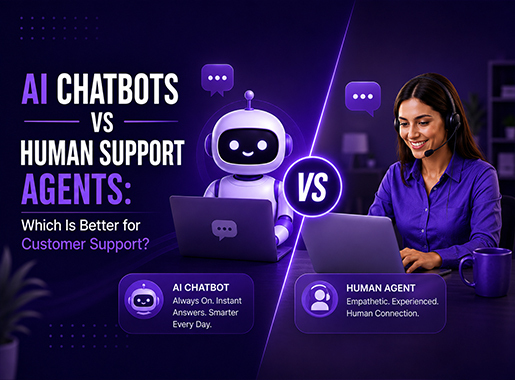
Can AI chatbots replace human support agents?
The answer is no.
Most conversational AI are only effective in automating routine requests and performing instant replies. They lack critical thinking and empathy required for complex problem solving.
For businesses, the most effective approach is a hybrid model.
They often use chatbots to resolve continuous inquiries, yet at the same time use human agents to manage sensitive and high value customer interactions.
Imagine, waking up in the morning and accessing your support dashboard at 8 AM on a Monday. You find hundreds of unresolved tickets sitting in the queue. The last thing customers hate is when they are kept waiting! Your staff might already be overwhelmed answering.
What’s your solution when you need a robust system that responds when neither you nor your team is available to assist your end customers? The answer is an AI chatbot.
Companies often struggle in understanding the significance of one solution over another. And this article will clearly discuss the nuance between these two solutions. .
What Are AI Chatbots?
AI chatbots are software applications programmed to simulate natural conversation with users. They use Natural Language Processing (NLP) and machine learning algorithms to interpret incoming questions, search connected knowledge bases, and generate highly accurate answers within milliseconds. In a support environment, bots act as a digital front-line filter.
They intercept incoming requests before those tickets ever reach your human staff. If you want to understand the underlying mechanics of this technology, read our guide on what is an AI chatbot to see how such systems manage workflows.
Chatbots are great at resetting passwords, providing shipping updates, and linking to standard policy documents. They can easily filter out the operational noise.
This way, your human agents can better focus on associated tasks which really matter.
What Are Human Support Agents?
On the other hand, human support agents are trained professionals hired to resolve your customers’ technical and account issues directly.
They operate the phones, answer the emails, and manage live chat queues. However, their actual value goes far beyond providing canned answers.
Human agents provide the essential elements of business that software simply cannot replace. For example, humans have critical thinking, contextual negotiation, and genuine empathy.
They can easily diagnose unpredictable technical problems, process complex refunds, and actively de-escalate tense situations with unhappy buyers.
So when a customer presents an unusual problem that falls outside standard company documentation, a bot may simply break down. However, a human agent investigates the issue across different departments and engineers up a real solution. They understand nuance, understand panic, and adjust their tone to preserve the relationship.
Research from PwC shows that 82% of consumers actively want more human interaction in their customer experience, especially when dealing with financial anxiety or account security.
AI Chatbots vs Human Support Agents
If you want to scale your operations without wildly inflating payroll, you must compare the specific capabilities of bots and people side-by-side.
| Feature | AI Chatbots | Human Support Agents |
| Availability | 24/7/365, without breaks, holidays, or downtime. | Limited to scheduled operating hours and shifts. |
| Cost | Fixed software subscription; near-zero marginal cost. | Hourly wages, benefits, hardware, and ongoing training. |
| Speed | Instant replies generated within milliseconds. | Subject to queue length, research time, and typing speed. |
| Accuracy | Extremely high for standard, structured FAQs. | High for nuanced, undocumented, or complex problems. |
| Scalability | Handles infinite simultaneous conversations effortlessly. | One agent handles 1–3 live chats at a time. |
| Personalization | Based strictly on structured account data and variables. | Based on dynamic conversational context and real empathy. |
| Complex Issue Handling | Low; requires strict parameters and documented paths. | High; utilizes lateral thinking and cross-department collaboration. |
Advantages of AI Chatbots
Here’s a list of advantages of integrating an AI customer support solution to change and manage your business’s incoming ticket volume.
- 24/7 Availability: Bots solve your coverage problem immediately. Customers in different time zones receive answers instantly without you needing to hire a dedicated night shift. You maintain basic support coverage around the clock.
- Instant Responses: Constant availability translates into zero wait times. A customer asking about your return policy receives a link the second they hit send. Eliminating queue anxiety drastically improves the user experience.
- Massive Cost Reduction: By deflecting tier-one support tickets, you dramatically reduce the workload on your human team. According to McKinsey, businesses can reduce customer service costs by up to 30% simply by implementing conversational AI.
- Infinite Scalability: Support volume might triple overnight during a flash sale. A bot handles 5,000 visitors exactly as easily as it handles five. Data from Statista projects the global chatbot market will reach $1.25 billion by 2025 based purely on this scalability factor.
If you are not sure how to streamline your support pipeline, SupportSuite247 brings AI chatbots, live chat, ticket management, and human support tools in one single platform helping businesses deliver more agile customer support. You can start free trial today.
Advantages of Human Support Agents
While bots excel at raw speed, real people provide the emotional intelligence necessary to solve highly sensitive situations and preserve brand loyalty.
- Genuine Empathy: Imagine a customer receives a damaged product just days before a major event. An AI automatically offering a standard 30-day return label will only increase their panic. A human agent assesses the gravity, expresses a genuine apology, expedites an overnight replacement, and rebuilds broken trust.
- Critical Thinking for Exceptions: Code bugs behave in unpredictable ways. An agent can ask clarifying diagnostic questions, request screenshots, and collaborate directly with the engineering team to find a temporary workaround.
- High-Stakes Negotiation: A long-term client might threaten to cancel their subscription due to a missing feature. An empowered staff member can review their account history and offer a custom, unadvertised discount to save the account. Machines lack this business judgment.
- Relationship Building: People want to do business with people. Having a human listen to a unique use case and offer tailored advice turns a frustrated user into an advocate. Data from Accenture confirms that 83% of consumers prefer dealing with human beings over digital channels to solve actual service issues.
Where AI Chatbots Perform Better
Automation works best for predictable, highly structured interactions. Bots excel in specific environments where the correct answers remain static over time.
- Routine Policy Questions (FAQs): Inquiries like “What are your business hours?”, “Do you ship internationally?”, and “How do I upgrade my plan?” require zero critical thinking. The bot delivers the factual answer instantly.
- Lead Qualification: A bot greets a new website visitor, asks three qualifying questions about budget and company size, and instantly routes the qualified lead to sales. HubSpot reports that businesses using bots for this type of qualification see significantly higher overall conversion rates.
- Order Tracking: Customers usually just want to know where their package is. An AI bot pulls data directly from your fulfillment software and displays the live tracking link within seconds. Data from Intercom shows that bots successfully resolve 33% of common queries like order status completely unassisted.
Where Human Agents Perform Better
People belong in situations requiring extreme flexibility, deep investigation, and emotional intelligence. They naturally handle scenarios that lack clear resolutions.
- Complaints and Escalations: A furious customer demanding to speak to a manager needs a real person to take over the conversation, actively listen, take accountability, and de-escalate the tension.
- Billing Disputes: Money is always sensitive. If a customer claims they were double-charged, an agent must review the payment gateway, understand the context, and explain the situation clearly. Research from Qualtrics confirms that financial anxiety requires immediate human intervention to prevent customer churn.
- Deep Technical Troubleshooting: Complex software issues require a person to ask diagnostic questions and interpret confusing user answers. Bots are limited to suggesting basic restarting procedures.
- Emotional Conversations: Interactions driven by anxiety or frustration demand someone who can read the tone of the room. According to Deloitte, empathetic customer service interactions directly drive long-term brand loyalty.
Can AI Chatbots Replace Human Agents?
Many executives ask if they can completely eliminate their support staff by installing the best AI chatbot software on the market and the answer is no.
AI should assist your humans, rather than fully replace them.
Bots lack true comprehension; they map user intent to programmed responses. When a customer uses highly unusual phrasing or presents a confusing, multi-part problem, it simply breaks the bot. The software then traps the user in a highly frustrating loop of irrelevant answers. However, when a human governs the situation, they monitor the conversations so they can jump in when the software gets confused or update the training data accordingly. Research from Harvard Business Review notes that companies attempting to replace their entire staff with AI experience often observe a sharp and immediate decline in their customer satisfaction score in just the first quarter. All because they lose the human element & conversational context.
The Best Customer Support Strategy: AI + Human Collaboration
The most efficient, high-growth companies do not choose between software and staff. They utilize a hybrid support model.
In a collaborative model, AI handles the repetitive tasks at the front gate. The bot greets the visitor, collects their account number, and asks for a brief description of the problem. If the problem is incredibly simple, the bot resolves it immediately and closes the ticket.
If the issue is complex, the bot instantly transfers the interaction to a live agent. Because the software already collected the vital account details, the human agent starts solving the problem immediately. This seamless handoff ensures higher efficiency. TechCrunch indicates that smooth API integration between bot and human channels reduces overall handle times by up to 40%.
This is exactly why businesses invest in unified solutions. By integrating live chat software and powerful AI deflection into a single interface, your agents act as specialized problem solvers rather than basic information providers.
Transform Your Support Workflow: SupportSuite247 combines AI chatbots, live chat, ticket management, and human support tools in one platform, helping businesses deliver faster and smarter customer support. Click here to view pricing plans.
How AI Chatbots Improve Customer Satisfaction
Customers value their time above everything else. Bots entertain this preference directly by delivering exponentially faster response times.
A buyer with a quick, simple question does not want to wait twenty minutes in a phone queue. A bot provides the exact answer they need in two seconds. This approach reduces wait times for everyone. And bots answer the simple questions automatically, ensuring your overall queue is shorter. Consequently, your human agents can answer the difficult questions faster.
Instant support builds absolute trust. Someone shopping on your website at 2:00 AM might have a quick question about sizing. Getting the correct answer quickly matters more to them than who delivers it. For instance, Salesforce reports that 68% of customers would rather use a chatbot to get an immediate answer than wait for a person to reply. Pairing this instant delivery with the best live chat software guarantees that even the most complex inquiries receive a prompt human resolution when necessary.
How Businesses Use AI Chatbots and Human Agents Together
Different industries apply this hybrid collaboration in highly specific, practical ways, entirely dependent on customer intent.
- SaaS and Software Companies: SaaS brands use bots to share help center articles and manage tier-one technical requests. If a user reports a 500 server error, the bot recognizes the technical complexity and routes the chat directly to a tier-two engineer.
- Ecommerce Brands: Retailers use bots for proactive engagement, offering discount codes to shoppers lingering on checkout pages. If a shopper asks a highly specific question about fabric quality, a live agent steps in to close the sale. Forrester notes that retail companies combining live chat with automation see higher average order values.
- Healthcare Clinics: Medical providers use bots to manage administrative tasks and schedule appointments. Real nurses then handle the actual questions about symptoms or test results. Information from IBM stresses that strict privacy regulations demand medical staff review for sensitive data.
- Financial Services: Banks use bots to quickly report account balances. Human bankers handle complex, high-trust tasks, such as processing mortgage applications and investigating fraud. Data from Bain shows that banks retain higher net promoter scores when human staff manage complex loan negotiations.
Common Mistakes Businesses Make with AI Support
Companies routinely damage their own reputations through poor AI implementation. Buying the software is the easy part; configuring it properly takes strategic effort.
- Over-Automation: Trying to force every customer interaction through a chatbot creates massive friction. A user trying to report a stolen credit card does not want to read an automated article about fraud prevention. They need to speak to a person immediately.
- No Human Fallback: Operating without an immediate escape hatch guarantees failure. When customers hit a dead end because a bot cannot answer their question, and there is no “Talk to Human” option, you will lose that customer.
- Poor Chatbot Training: Bots are only as smart as the documentation you feed them. If your internal knowledge base is outdated, your AI will confidently deliver incorrect information. Nielsen consumer research indicates that repeating information to a bot and then to a human is the number one frustration in modern service.
- Forcing Customers Through Bots: Ignoring a customer’s clear request to speak to an agent creates resentment. Gartner states that creating high-effort experiences directly drives customer disloyalty. To avoid these traps, teams should adopt live chat best practices that perfectly balance automation with human accessibility.
Future of AI Customer Support
Technology is changing quite dramatically. Most support agents are not just disappearing, they have better tools at their expense which they are constantly upgrading.
- AI Copilots and AI Replies: Support agents will soon rely heavily on AI copilots. The copilot reads the customer’s text and suggests a drafted reply. The agent acts as a skilled editor, reviewing the text, clicking approve, and sending the message, creating massive team efficiency.
- Predictive Support: AI tools will actively monitor user behavior. If the system notices a user failing to complete a checkout process three times, it will proactively trigger a chat widget offering specific help for that exact billing error.
- Sentiment Analysis & Intelligent Routing: Algorithms will read the underlying tone of incoming messages. If a customer uses highly aggressive language, the system bypasses the friendly bot entirely and routes that ticket directly to a senior de-escalation manager. A study from MIT Sloan suggests intelligent routing based on emotional state will become a standard feature shortly.
Conclusion
Deciding between customer support automation and live staff presents a false choice for most business owners. You need both to run a modern, highly efficient operation. AI chatbots are essential for managing high ticket volume and providing instant answers to routine questions. Conversely, human support agents are vital for managing deep operational complexity and building long-term trust through actual empathy.
If you want to protect your staff from burnout while giving your customers the fast, accurate service they demand, you must implement a smart hybrid model. Before you overhaul your pipeline, read What Is Live Chat? to understand the foundational layer of real-time communication. Start auditing your support queue today. Identify the repetitive, low-value questions you can safely automate, and empower your staff with the tools they need to handle the tough cases that remain.
Ready to Scale Your Customer Experience?
SupportSuite247 combines AI chatbots, live chat, ticket management, and human support tools in one platform, helping businesses deliver faster and smarter customer support.
Start Your Free Trial Today.