
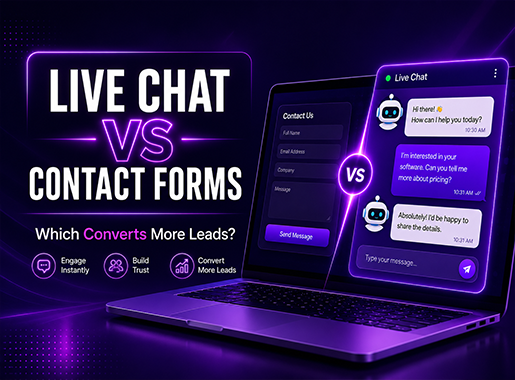
A potential buyer lands on your pricing page. They have a specific question about your software integration. They click your “Contact Us” button and face a static page with eight empty text fields demanding their name, email, phone number, job title, and company size. Frustrated, they close the tab and check out your competitor instead. So what just happened? You lost a qualified lead.
So which converts more leads? Dedicated live chat software typically converts more leads because it provides real-time engagement, instant answers, and faster communication. Contact forms are useful for structured inquiries, but now businesses focus more on lead generation and often achieve better results with live chat.
Website visitors expect immediate answers. And when you force buyers to wait hours or days for a response, their buying intent cools. Are you eager to learn which converts better? Here’s how the two communication channels actually work, backed by data, to help you understand what captures more attention on a website.
What Is Live Chat?
Live chat is a real-time messaging tool that sits on your website. It usually appears as a small widget in the bottom corner of a user’s screen. When visitors have a question, they click the widget and type their message. A sales representative or support agent replies instantly from a unified inbox.
The mechanics are simple but highly effective for customer engagement. Instead of forcing a user to move away from the product page they are reading, live chat opens a direct line of communication right there. If you want to understand the exact technical setup and common features, read our guide on what is live chat, how it works, and why businesses use it.
What Are Contact Forms?
A contact form is a static block of data entry fields embedded on a web page. Visitors type their information into boxes, click a submit button, and wait for a reply. The website then sends this submitted data to a company email address or customer relationship management database.
Contact forms represent the traditional method of lead collection. Businesses have used them for decades to gather customer inquiries, support tickets, and quote requests. They are asynchronous. The visitor sends a message into the void and trusts that a human will eventually read it and reply.
Live Chat vs Contact Forms – A Quick Comparison
| Feature | Live Chat | Contact Forms |
| Speed | Instant | Hours or days |
| Lead Conversion | High | Low to moderate |
| Customer Engagement | Proactive and two-way | Reactive and one-way |
| Response Time | Seconds | 12 to 24 hours average |
| User Experience | Conversational and low friction | Often tedious and high friction |
| Automation | High (via AI chatbots) | Low (basic auto-responders) |
| Availability | 24/7 with bots, limited with humans | 24/7 collection, delayed processing |
| Best Use Case | Immediate sales questions, support | Complex project details, legal inquiries |
Why Visitors Leave Contact Forms?
Users abandon contact forms because they create mental frustration. Every required field you add to a form decreases the probability that a user will finish it.
Data from HubSpot shows that average form conversion rates hover between 1% and 3%. Most website visitors simply refuse to fill them out. There are four specific reasons for this behavior.
First, long forms feel like homework. A buyer wants a simple answer to a simple question. Asking for their phone number and job title before answering their question feels invasive.
Second, the waiting period kills momentum. B2B buyers operate on tight schedules. They research products during narrow windows of free time. They know that submitting a form means waiting 24 hours for a sales rep to email them to schedule a discovery call.
Third, forms lack engagement. They offer zero immediate value to the user. The user gives away their personal data and gets nothing in return except an automated “We received your message” confirmation page.
Fourth, form fatigue is a real psychological barrier. Modern consumers fill out forms to buy groceries, sign up for software, and pay bills. When they encounter another form while researching a simple purchase, they often choose to leave the website entirely.
Why Live Chat Generates More Leads
Live chat removes the friction associated with traditional data capture. When a visitor has a question, they type it into a box and get an answer. The conversation happens immediately.
This instant interaction matches modern consumer behavior. According to Intercom, website visitors who chat with a business are 82% more likely to convert into customers.
The primary advantage is proactive engagement. A contact form waits passively for someone to find it. A live chat widget can actively greet a visitor based on their behavior. If a user spends three minutes staring at your pricing page, a chat prompt can appear asking, “Do you have any questions about our pricing tiers?”
This approach answers questions while the buyer’s intent is at its highest point, which is a proven way to increase website conversions. The customer does not have to hunt for a contact page. They receive immediate answers to objections that might otherwise prevent a purchase.
Want to convert more website visitors into leads? SupportSuite247 combines live chat, AI chatbots, visitor tracking, and automation to help businesses engage customers instantly and capture more opportunities. Start your free trial today.
Response Time – The Biggest Conversion Factor
Speed dictates lead generation success.
The longer you wait to reply to an inquiry, the less likely you are to close a deal.
A study published in the Harvard Business Review found that companies responding to leads within five minutes are 100 times more likely to connect with that prospect than companies that wait 30 minutes. After five minutes, the odds of qualifying the lead drop by 80%.
Contact forms almost guarantee you will miss this five-minute window.
Data from SuperOffice reveals that the average customer service response time for an email inquiry is over 12 hours. By the time your sales team replies to a form submission, the prospect has already spoken to a competitor who uses live chat.
Live chat forces a fast response time. The median first response time for live chat is less than 45 seconds. This speed capitalizes on the exact moment the buyer is thinking about your product.
Customer Experience Comparison
The gap between waiting for an email response and having an instant conversation changes how a customer views your entire brand.
When a user submits a contact form, they experience anxiety. They do not know if the form actually worked. They do not know if their message went to an unmonitored inbox. They check their email for confirmation, and then they wait.
Live chat provides immediate relief. A customer asks a question, sees a typing indicator, and gets a resolution. Research from Zendesk confirms that live chat has the highest customer satisfaction level of any support channel at 73%, compared to 61% for email.
If you want a deeper breakdown of how chat compares specifically to email communication, review our analysis on live chat vs email support to see which is better for customer service.
How AI Chatbots Improve Lead Capture?
Many businesses resist live chat because they cannot afford to staff agents 24 hours a day. AI chatbots solve this problem.
An AI chatbot is a software program that simulates human conversation. It greets visitors, answers common questions, and collects contact information when your human agents are asleep. Chatbots excel at lead qualification. Instead of presenting a static form, the bot asks a series of conversational questions.
“Hi! What brought you to our site today?” The user replies. “Great, I can help with that. What is your email address so I can send you the documentation?”
The bot captures the lead naturally. Gartner research predicts that by 2027, chatbots will become the primary customer service channel for roughly a quarter of all organizations. A study by McKinsey also found that companies investing in customer support automation see massive reductions in service costs while improving response times.
SupportSuite247 includes powerful chatbot features that handle this exact workflow. The bot engages the user, captures their email, and routes the qualified lead directly to your sales team the next morning.
Ready to capture leads while you sleep? SupportSuite247 lets you build automated chat workflows that qualify visitors 24/7. Start your free trial today.
When Contact Forms Still Make Sense?
Despite the advantages of live chat, contact forms still have a specific place in business communication. You should use them for complex or highly structured requests.
Legal inquiries require forms. If a client needs to submit a detailed case summary or upload sensitive documents, a secure web form is the correct tool.
Complex project requests also benefit from forms. If you run a custom manufacturing business, you cannot provide an accurate quote through a two-minute chat. You need the prospect to submit exact dimensions, material preferences, and architectural drawings.
Detailed submissions require time. Users prefer forms when they need to draft a long message, attach multiple files, or explain a multi-step problem that does not require an immediate back-and-forth conversation.
When Live Chat Is The Best Option?
Live chat dominates in fast-paced commercial environments. If your goal is to capture commercial buyer traffic and drive sales, chat outperforms forms in almost every scenario.
SaaS websites rely on live chat to explain complex software features quickly. A buyer might want to know if an application integrates with Salesforce. A quick chat provides a “yes” and a link to the documentation, saving the sale.
Ecommerce stores use chat to prevent shopping cart abandonment. If a shopper is confused about return policies or shipping costs at the checkout page, a fast answer from a chat widget prevents them from leaving empty-handed.
Service businesses and agencies capture more local traffic when utilizing live chat for small businesses. A homeowner with a burst pipe will not fill out a form and wait until tomorrow. They will chat with a plumber who can confirm availability immediately.
What is the Best Way? Combine Live Chat with Contact Forms
You do not have to choose just one. The most effective website lead generation strategy combines both tools.
Use live chat on high-intent pages. Place your chat widget on pricing pages, product features pages, and checkout screens. This captures users who are actively making a buying decision and need fast answers.
Use contact forms on your dedicated “Contact Us” or “Support” pages. This provides a fallback option for users who want to submit a detailed inquiry outside of business hours or prefer asynchronous communication.
Modern chat widgets actually function as hybrid tools. When your team goes offline, the chat widget can automatically convert into a lead capture form. The user types their message, enters their email, and the system sends it to your inbox as a standard ticket.
Here’s What We Learned at SupportSuite247!
After analyzing millions of website interactions across our platform, we discovered several truths about lead generation that run counter to standard industry advice.
Most businesses overestimate how many conversations should remain fully AI-driven. Relying entirely on bots frustrates users who have complex problems.
We’ve found that forcing users through automation loops damages trust faster than long wait times. If a bot cannot answer a question within two prompts, it must immediately offer a clear path to a human agent or a clean way to leave an email address.
Shorter forms do not always mean higher quality leads. While reducing fields from seven to three increases the raw number of submissions, we noticed that sales teams spend more time disqualifying those extra leads. Chat avoids this entirely by qualifying the user through natural dialogue before asking for contact details.
Finally, proactive chat works best when it is specific. A generic “How can I help you?” pop-up is annoying. A message that says, “I see you are looking at the Enterprise plan, do you have questions about custom integrations?” converts at a much higher rate.
How SupportSuite247 Helps Capture More Leads?
If you want to implement these strategies, you need the best live chat software built specifically for conversion. SupportSuite247 provides everything required to replace clunky forms with high-converting conversations.
The Live Chat Widget installs on your site in minutes and provides a clean, fast interface for visitors. It loads instantly and works flawlessly on mobile devices.
Our AI Chatbot builder allows you to create custom conversation flows. You can set up bots to handle FAQs, book meetings directly onto your sales calendar, and route specific questions to the right departments.
We include comprehensive visitor tracking. You can see exactly which page a user is looking at, how long they have been there, and their geographic location before you even say hello. Read our Visitor Tracking Guide to see how this data helps sales teams close deals.
The Unified Inbox brings everything together. Whether a lead comes through a live chat, an offline form submission, or a social media message, your team manages it from one single dashboard. Lead Capture Automation automatically logs every new contact into your CRM.