
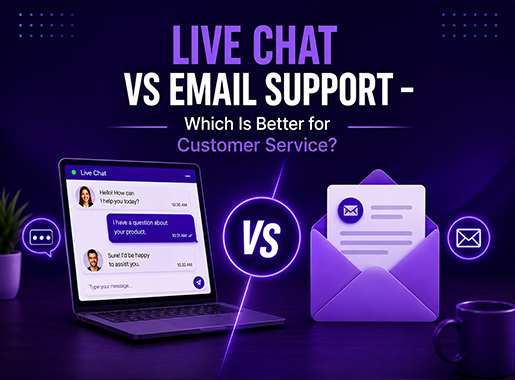
Is live chat better than email support? Live chat is generally better for speed, engagement, and conversions, while email support remains useful for complex issues and detailed documentation. Most businesses benefit from using both channels together.
Choosing the right support channel changes how your customers view your brand. If a buyer cannot get an answer during checkout, they abandon their cart. If a software user encounters a bug and cannot send a screenshot to your engineering team, they cancel their subscription. The debate between live chat and email support often frames them as competitors. In reality, they serve entirely different purposes.
What Is Live Chat?
Live chat is a real-time communication tool embedded directly into a website or application. It allows visitors to type messages and receive immediate responses from a human agent or an AI chatbot.
A customer clicks a small widget in the corner of their screen, types a question, and starts a conversation. Because the interaction happens entirely within the browser, the customer never has to open a separate application. It keeps them on your website while they receive help.
Common use cases for live chat include answering pre-sales questions, guiding users through checkout, resolving simple account access issues, and directing visitors to specific product pages. When a customer gets stuck, live chat provides immediate relief.
Read more about what is live chat, how it works, and why businesses use it.
What Is Email Support?
Similar to the common discussions of live chat vs contact forms, email support is an asynchronous communication channel where customers send messages to a dedicated company address and wait for a reply. It is the oldest digital customer service method and remains the default choice for formal business interactions.
Customers explain their problem, attach files, and send the message. The inquiry enters a ticketing system. A support agent claims the ticket, investigates the issue, and writes a detailed response. The customer reads the reply hours or days later.
Common use cases for email support include handling complex technical troubleshooting, processing legal or billing disputes, sending detailed onboarding instructions, and managing multi-step return processes.
How Live Chat vs Email Support Compares with Each Other?
| Feature | Live Chat | Email Support |
| Speed | Instant (Under 1 minute) | Delayed (Hours to days) |
| Customer Satisfaction | High for simple, urgent issues | High for complex, detailed issues |
| Lead Generation | Excellent for capturing active buyers | Poor for active sales, good for nurturing |
| Convenience | High (in-app, immediate) | Moderate (requires leaving the app, waiting) |
| Customer Engagement | Very high | Low |
| Availability | Requires staffed shifts or AI bots | 24/7 submission, queued for business hours |
| Automation | High (Chatbots, quick replies) | Moderate (Auto-responders, macros) |
| Best Use Case | E-commerce sales, quick SaaS fixes | Deep technical support, document sharing |
Looking for an AI live chat platform that combines live chat, email support, AI chatbots, ticket management, and visitor tracking in one place? Start your free trial with SupportSuite247 today.
Response Time – Which Is Actually Faster?
Live chat completely dominates in raw speed.
Customers approach a chat widget with intense temporal expectations. Data from HubSpot indicates that 90% of customers rate an “immediate” response as essential when they have a customer service question. They define “immediate” as 10 minutes or less.
However, top-performing support teams push live chat metrics much further. They target a First Response Time (FRT) of under 45 seconds. The immediate nature of chat stops customers from abandoning a checkout process out of frustration.
Email operates on a completely different timeline. A study by SuperOffice found the average response time for a customer service email is roughly 12 hours. Many enterprise Service Level Agreements (SLAs) consider a 24-hour turnaround entirely acceptable.
A 12-hour delay is perfectly fine if a customer is asking about a software feature they plan to use next month. That same delay is unacceptable if a customer is trying to complete a $500 purchase right now and their credit card keeps declining.
Lead Generation & Sales Impact
Live chat functions as a proactive sales tool. Email is almost entirely reactive.
When a visitor lingers on a pricing page for two minutes, the best live chat software can trigger an automated prompt asking if they need help comparing tiers. Forrester Research reports that website visitors who use web chat are 2.8 times more likely to convert than those who do not. The agent can immediately address objections, offer temporary discount codes, and push the prospect toward a purchase.
Email cannot capture this active intent. By the time a customer decides to copy an email address, open their mail client, and draft a message about a product they are considering, they have already lost momentum.
Support Efficiency
Efficiency looks completely different depending on the channel you evaluate.
Live chat generates efficiency through concurrency. A trained support agent can realistically handle three to four chat conversations at the exact same time. While one customer is typing their account number, the agent is answering a shipping question for another. This concurrency drastically lowers the cost per interaction.
Email forces single-tasking focus. An agent opens one ticket, reads the context, drafts a solution, and hits send before moving to the next. McKinsey notes that this asynchronous deep work is necessary for complex problem-solving.
Measuring these channels against each other using the same metrics causes operational failure. If a manager forces a live chat agent to keep their Average Handle Time under five minutes, that agent will start rushing customers. They will give incomplete answers just to close the chat. This forces the customer to write an email later anyway.
Customer Satisfaction – Which Do Customers Choose?
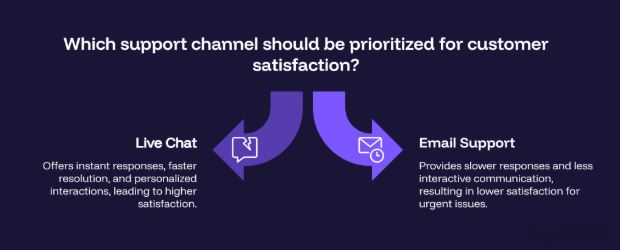
Customers base their satisfaction on how well the channel matches their immediate needs.
HubSpot research reveals that 90% of customers rate an immediate response as important when they have a question. This preference for instant gratification naturally pushes satisfaction scores higher for live chat. For simple inquiries, live chat achieves average satisfaction scores between 73% and 87%. Customers appreciate the convenience of getting an answer without leaving the page they are reading.
However, customer satisfaction with email support depends heavily on the effort required to get an answer. The SQM Group found a direct correlation between First Contact Resolution and satisfaction. Every time a customer has to reply to an email because the agent missed a detail, satisfaction drops.
We have observed a specific pattern. Customers do not hate waiting for an email; they hate uncertainty. If an email autoresponder promises a reply within two hours and delivers on that promise, satisfaction remains high. If a live chat agent replies instantly but fails to solve the problem, satisfaction plummets.
When Email Support Is Better
Businesses should route specific types of interactions away from chat and directly into an email queue.
Detailed documentation requires email. If your product requires users to send identification documents, tax forms, or signed contracts, a chat widget is the wrong environment. Email creates a clean, searchable audit trail.
Complex technical issues belong in an inbox. B2B software companies often need days to resolve bugs. An agent needs to pass the ticket to a developer, who might need to push a code update. Email keeps all internal notes and external replies organized in one central thread.
Legal and compliance communications must use asynchronous channels. Refund disputes, terms of service violations, and account bans require carefully drafted, manager-approved responses. You do not want frontline agents improvising these answers in a real-time chat window.
When Live Chat Is Better
Live chat excels at clearing immediate roadblocks.
Sales inquiries are the most obvious use case. E-commerce stores see massive spikes in cart abandonment when shipping costs are unclear. A simple chat widget allowing a user to ask “Do you ship to Canada?” saves the sale instantly.
Onboarding new users works best via chat. When a new SaaS customer logs in for the first time, they often get stuck on basic setup steps. An in-app chat widget lets them ask quick questions without navigating away from the dashboard they are trying to learn.
Customer engagement relies on low barriers to entry. Many users will not bother writing an email to report a broken link or a small typo on your website. They will, however, take five seconds to drop a note in a chat box. This steady stream of micro-feedback helps businesses fix minor issues before they impact a larger audience.
Start your free trial with SupportSuite247 today.
Why Businesses Use Both Channels
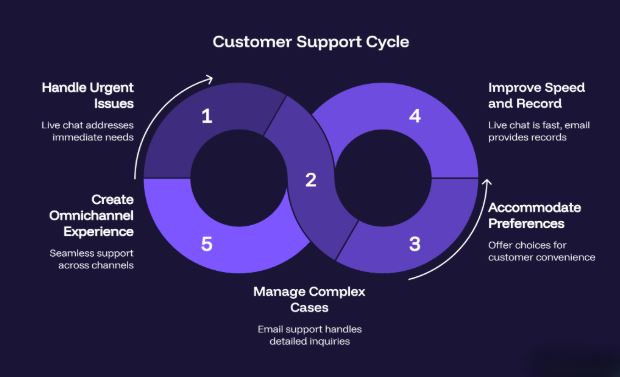
Consumers do not think in terms of channels. They think in terms of convenience.
A customer might start a live chat on their phone while riding the train. They ask a quick question about a missing feature. The agent realizes the request requires a custom script. Instead of making the customer wait on their phone, the agent transitions the chat into an email ticket. The customer receives the solution in their inbox three hours later.
This is omnichannel support. Harvard Business Review found that 73% of retail consumers use multiple channels to interact with a single brand. Businesses combine live chat and email to cover both speed and depth. Live chat acts as the frontline triage unit. Email acts as the specialized problem-solving department.
Here’s What Our Experts Learned Scaling Support
Building customer service operations for growing companies teaches you hard lessons about human behavior and live chat best practices. And some of them, we learned through our experiences.
Most businesses overestimate how many conversations should remain fully AI-driven. Founders often buy into the idea that bots can handle 90% of their volume. The reality is much lower. We’ve found that forcing users through automation loops damages trust faster than long wait times. If a customer types “talk to a human” three times, and the bot keeps suggesting help articles, that customer will likely cancel their account.
Never measure live chat success solely on how fast an agent replies. Fast, wrong answers destroy customer loyalty. Give your team the authority to take a few extra minutes on a chat to actually solve the root problem.
Email auto-responders must be helpful. Do not just send a blank message saying “We received your request.” Include links to your top three FAQ articles and clearly state your current response time. Setting a realistic expectation prevents the customer from sending three more emails asking for updates.
How AI Is Changing Customer Support
Artificial intelligence has fundamentally altered the economics of customer service. You no longer have to choose between speed and cost.
Customer support automation handles the repetitive volume that normally burns out human agents. AI chatbots intercept incoming chats and resolve standard questions about order tracking or return policies in seconds. This provides the instant gratification of live chat without requiring a human to type the same answer fifty times a day.
AI also changes email. Modern systems read incoming emails, categorize the intent, and route the ticket to the correct department automatically. They generate draft replies for agents to review, cutting email handling time in half.
Read more about AI Chatbots vs Human Support Agents.
Are you searching for an all-in-one customer service solution that integrates email and live chat with visitor tracking, ticket management, and AI-powered chatbots? Start your free trial today and try SupportSuite247 free.
Your Best Bet – Live Chat + Email + AI
The debate between live chat and email is a trap. The best customer support strategy requires a unified system.
You need live chat to capture active buyers and solve quick problems. You need email support to handle complex investigations and maintain permanent records. You need AI to filter out the noise and handle repetitive questions so your human agents have time to breathe.
When you force a customer to use a channel that doesn’t fit their problem, you create friction. When you offer them the right tool at the exact moment they need it, you build loyalty.