
We asked what are the top three frustrations consumers face with traditional chatbots…
And we learned, 43% complained they are failing to resolve issues, 38% complained they get stuck in an endless loop and 37% said they had to repeat themselves over and over.
Also, Stanford MIT 2026 reports, AI chatbots cut onboarding time by 34%.
If you have ever become a victim yourself of customer service purgatory, you’re not alone. The problem isn’t automation, it’s the script the traditional bots use.
Traditional chatbots force humans to talk like computers…
But that’s all over now with modern AI agents as they change the script by actually understanding human intent and quietly resolving up to 93% of customer issues without a single dead end. If you want to see how your business can transition away from rigid scripts, explore our comprehensive guide on Customer Support Automation.
Wondering how traditional chatbots are different from AI chatbots?
This article will explain just that.
But before we get into the details, let’s learn what they are.
What is a Traditional Chatbot?
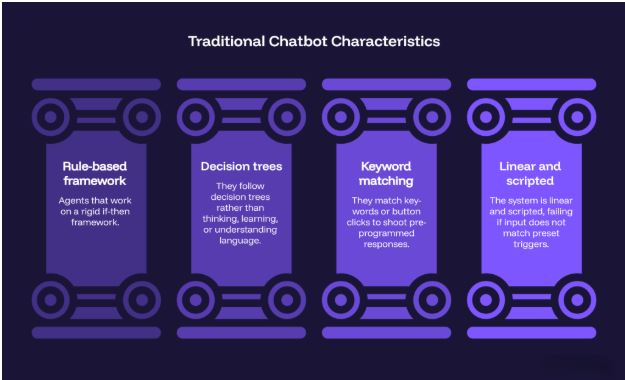
Traditional chatbots are rule based agents that work on a rigid if-then framework.
They follow decision trees, which means they do not think, learn, or understand language the way an AI based chatbot could. They simply match keywords or button clicks to shoot pre-programmed responses written by a human developer.
You can think of them like an automated phone menu.
If you Press 1, it will track, if you Press 2, it will send returns. So let’s say if a customer types a phrase that doesn’t perfectly match their preset triggers, the system fails.
In short, they are linear and scripted.
What Is an AI Chatbot?
AI chatbots are powered by Large Language Models (LLMs) & Natural Language Processing (NLP).
Unlike traditional chatbots, they don’t rely on a pre-written script, they dynamically generate responses in real time based on the data they have been trained on or given access to.
They understand the meaning and intent behind human language. If a user makes a typo mistake, uses slang or asks multiple questions at once, it won’t break.
They are adaptive and contextual which means they can recall information from previous conversations. They synthesize a unique answer from a massive internal knowledge base all the while keeping a natural and fluid dialogue with its users.
If you want to learn more about AI Chatbots, read our article on:
What is an AI Chatbot? Benefits And How It Works
How Traditional Chatbots Compare to AI Chatbots?
Let us help you provide an informative comparison with a detailed side-by-side breakdown of the two systems. It will help you decide which concept is better for your usage.
| Feature | Traditional Chatbots (Rule-Based) | AI Chatbots (Generative/Conversational) |
| Intelligence | Operates strictly on rigid “if-then” logic and decision trees. | Uses Large Language Models to process concepts, context, and unstructured text. |
| Learning Ability | Static; requires manual developer coding for every new dialogue path. | Dynamic; adapts quickly by simply ingesting new documents or knowledge bases. |
| Natural Language Understanding | Relies on exact keyword matches and breaks when faced with typos or slang. | Understands user intent, easily handling typos, slang, and multi-part questions. |
| Personalization | Limited to inserting basic database variables like a user’s first name. | Deeply contextual; tailors tone and solutions based on past interactions. |
| Automation | Excels only at simple, highly predictable tasks like checking a balance. | Solves complex edge-cases by synthesizing information across multiple systems. |
| Scalability | Expanding requires building entirely new, complex conversational flows from scratch. | Scales almost instantly across languages and topics without rewriting core logic. |
| Cost | Cheap to launch, but incurs high ongoing developer costs for constant maintenance. | Higher initial setup and API costs, but drastically lower long-term maintenance. |
| Customer Experience | High-friction; often traps users in frustrating loops until a human takes over. | Fluid and human-like; quietly resolves the vast majority of issues hands-free. |
The Pros and Cons of Traditional Chatbots
Let’s check out some of the pros and cons of traditional chatbots to better understand them.
The Pros
Absolute Brand Control: Since you write every single response yourself, there is no risk of the bot imagining facts, making up weird policies, or saying something embarrassing. It sticks strictly to the script.
High Security and Compliance: For industries with strict legal, medical, or financial regulations, traditional bots are often easier to push through compliance reviews because there is no dynamic or unpredictable text generation.
Lower Upfront Costs: Building a simple decision-tree bot is relatively inexpensive. Unlike generative AI, there are no ongoing token-based usage fees for processing language.
Perfect for Simple, Linear Tasks: These bots work well for repetitive jobs. If a customer just wants to check an order status, reset a password, or get routed to the billing department, clicking a few buttons gets it done quickly.
Fast Deployment for Basic Needs: If a business only needs to automate 3 to 5 very common FAQs, a rule-based bot can be mapped out and deployed in a matter of days.
The Cons
Zero Flexibility: These bots rely entirely on exact terms. If a customer makes a typo, uses slang, or asks two questions at once, the logic breaks. The customer then gets stuck in a loop of “I didn’t get that, please try again.”
High Maintenance at Scale: They are cheap to build but expensive to grow. Every time a company launches a new product or updates a policy, a developer must manually map out and code entirely new conversational branches.
No Memory or Context: They have “goldfish memory.” They treat every single user input as an isolated event and cannot remember what a user said two messages prior, forcing customers to repeat themselves.
High Escalation Rates: Because they hit a wall with anything mildly complex, they frequently force users to escalate the issue to a live human agent anyway, defeating the ROI purpose of automation.
Poor Customer Experience: They force people to adapt to rigid rules. Because they cannot understand normal speech, customers get annoyed and simply close the chat window. This is why modern brands are upgrading from rigid scripts to intelligent, real-time Live Chat systems that blend human touch with instant AI responsiveness.
The Pros and Cons of AI Chatbots
The Pros
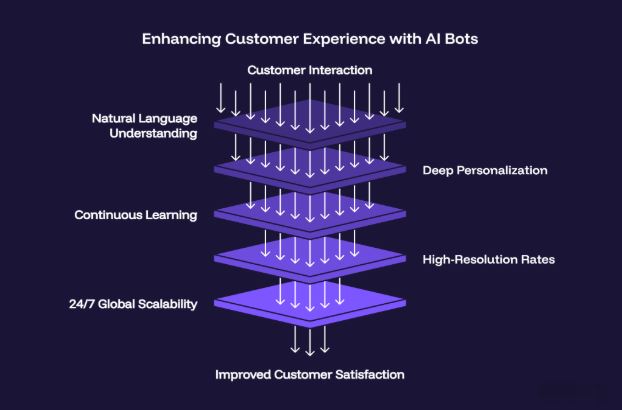
Advanced Natural Language Understanding: Older bots broke down if you did not type the exact right keywords. Modern bots are different because they grasp what people actually mean. They handle typos, slang, complicated multi-part questions, and sudden changes in topic without getting confused.
Deep Personalization: These systems remember you. They look at your past orders, previous conversations, and what you are doing on the site to tailor the experience. Instead of feeling like a support ticket number, you feel like the company actually knows you.
Continuous Learning: AI gets smarter without constant programming updates. When policies change or new manuals come out, you just upload the documents. The system reads them and learns how to answer new questions immediately, without developers writing a single line of code.
High-Resolution Rates for Complex Issues: Instead of just handling simple FAQs, these tools pull information from different databases to fix tricky, unusual problems. This means far fewer customer complaints get passed off to human support staff.
24/7 Global Scalability: They work all day and night. Because large language models already understand dozens of languages, a single setup can support customers around the globe. You do not need to hire local support teams for different countries.
The Cons
The Risk of “Hallucinations”: The biggest issue with this technology is its habit of lying with complete confidence. If a bot invents a fake refund policy or promises a feature that does not exist, customers get angry and the company has to deal with the legal and reputation issues.
Data Privacy and Security Concerns: AI requires massive amounts of data to function. In fields with strict regulations, like banking or medicine, sending private customer data through these systems is risky. Keeping this information secure and meeting legal standards requires a lot of expensive oversight.
Higher Initial Setup Costs: They save money over time, but setting them up is not cheap. Building a secure system that matches your brand requires a lot of upfront spending on connections, cleaning up data, and training the model.
Lack of True Emotional Intelligence: A computer can mimic sympathetic phrases, but it does not actually feel anything. When a customer is dealing with a stolen card, a canceled flight, or a family emergency, fake care from a machine can feel cold and irritating.
Unpredictability: Because these models write responses word-by-word in real time rather than sticking to a pre-written script, you cannot dictate exactly how they will word their answers. This unpredictability makes some protective brands nervous.
Which Business Should Use Which?
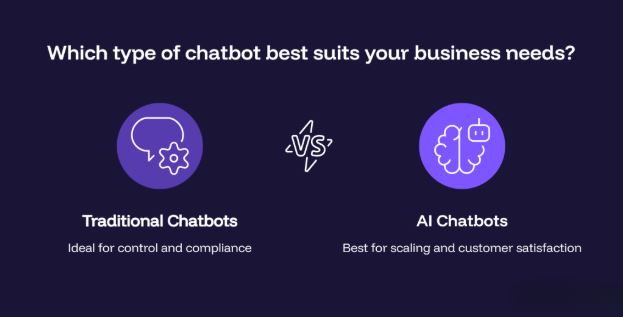
Now that we know the pros and cons of each chatbot solution, let’s check out which businesses should focus on what chatbot solutions and why.
When to Choose Traditional (Rule-Based) Chatbots?
Traditional chatbots are the best choice when a business needs absolute control.
They follow strict compliance, and 100% deterministic outputs.
If the cost of the bot saying the “wrong thing” is high, rule-based is the way to go.
It’s best for Small-to-medium businesses (SMBs) with tight budgets. It’s also good for enterprise departments that only handle highly structured internal workflows.
Best Industries:
- Healthcare: Where giving unverified medical advice or violating patient privacy (e.g., HIPAA) is a massive liability.
- Banking & Finance: Where precise, legally approved language must be used for compliance.
- Government & Legal: Where processes are rigid and policies must be stated verbatim.
Their Perfect Use Cases:
They are good for linear, transactional workflows such as responding to prompts like “Reset Password,” “Check Account Balance,” and “Track My Order”
They are also useful for processing straightforward cancellations or refunds.
As for internal enterprise communication, they are good for internal employee IT ticketing, like routing a broken laptop request to the hardware team.
When to Choose AI (Generative) Chatbots?
AI chatbots are the suitable choice when a business wants to scale. They deal with customer inquiries which are otherwise difficult for traditional chatbots to deal with.
They drive revenue by running through conversational experiences.
If you’re a scaling startup, high-volume enterprise or business with a global customer base, and your need is to automate complex support without sacrificing customer satisfaction.
Best Industries:
- E-commerce & Retail: For handling varied product inquiries, personalized recommendations, and complex return scenarios.
- SaaS & Technology: For deep, context-aware technical troubleshooting.Travel & Hospitality: For managing dynamic booking changes and multi-language support.
- Real Estate: For dynamic lead qualification where follow-up questions must adapt to what the prospect says
Their Perfect Use Cases:
They are best for handling hundreds of unique and random questions which don’t fit into a standard FAQ.
They help with selling and personalized cart-recovery conversations.
They can offer instant multilingual support across global markets without hiring localized teams.
They are good at synthesizing information from large, constantly updating knowledge bases.
Why Does SupportSuite247 Use AI?
At SupportSuite247, we didn’t build our platform on traditional, rule-based chatbot architecture for one simple reason: our clients’ customers don’t speak in rigid scripts.
Traditional chatbots force users into frustrating, linear loops, often ending in “I didn’t understand that.”
In today’s fast-paced digital economy, that friction translates directly to lost revenue and damaged brand loyalty.
By building our suite around advanced generative AI, we resolve the core pain points of modern customer support.
Here is exactly why SupportSuite247 uses AI to power the future of customer experience:
True Intent Understanding
SupportSuite247 uses advanced NLP to understand customer intent, even with typos, slang, or complex questions, delivering accurate, conversational responses.
Smarter Problem Solving
Instead of rigid decision trees, our AI searches your knowledge base, FAQs, and documentation to resolve unique customer issues in real time.
Context-Aware Conversations
Our AI remembers previous messages, so customers don’t have to repeat themselves, making conversations natural and seamless.
Continuous Learning
Update a document or sync your knowledge base, and SupportSuite247 instantly learns new products, policies, and information without manual bot training.
Deep Integrations & Personalization
Connect your CRM, order management, and other business systems to provide real-time, personalized support, from order tracking to returns and account updates.
Ready to Leave the “Loop of Doom” Behind?
Don’t let rigid, outdated scripts frustrate your customers and drive up your support costs.
Discover how SupportSuite247’s AI-powered chatbot improves customer support by delivering natural, human-like conversations that resolve issues instantly.
Ready to scale your support? Check out our Pricing plans today, or get started with a free trial to see the AI difference firsthand.