
Customer attention spans have never been shorter, and expectations have never been higher.
Today, many website visitors leave without buying, booking, or contacting anyone.
It happens even when your product is excellent, your pricing is highly competitive, and your website is beautifully designed.
In many cases, visitors bounce not because they lose their interest, but just because they couldn’t find the answer to a highly specific unanswered question.
Perhaps it is a concern about international shipping times. Maybe they are evaluating a B2B SaaS platform and are unsure which subscription tier fits their team’s specific size and compliance requirements.
When buyers cannot find these answers immediately, hesitation sets in. They lose momentum, close the tab, and move on to a competitor whose site is easier to understand.
Here’s when Live chat solves this systemic problem by providing a direct line to your team at the exact moment a buyer’s intent is at its highest.
Instead of spending tens of thousands of dollars on a complete website redesign, did you know placing a targeted, conversational chat widget on high-intent pages offers an immediate, measurable lift in revenue?
Let’s find out how.
How Live Chat Directly Impacts Your Conversion Goals
Every marketing effort you launch eventually points back to your website, making your conversion rate the most critical metric in your business.
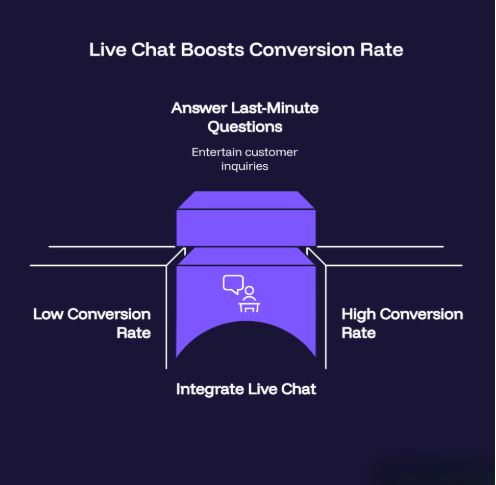
Live chat directly influences your primary conversion goals, whether that means completed checkouts in an e-commerce store or qualified demo bookings for a B2B SaaS provider.
Even a microscopic increase in your website’s conversion rate (calculated as total conversions / total visitors) can completely change your annual revenue trajectory.
Let’s break down the math for a standard mid-market business. If your site generates 5,000 visitors a month and secures 100 purchases, your baseline conversion rate is:
100 purchases / 5,000 visitors = 2.0%
If implementing live chat helps you answer enough last-minute questions to bump that rate to just 3.0%, you have effectively increased your total sales by 50% without spending an extra dime on advertising or traffic acquisition. When applied to high-ticket B2B software where a single contract might be worth $20,000 annually, the ROI of that 1% lift becomes astronomical.
The Staggering Cost of Delayed Responses
Most visitors do not arrive on your website ready to enter their credit card information immediately. Modern buyers require multiple touchpoints, and during their research phase, friction is your absolute biggest enemy. Visitors abandon their journeys because:
- They cannot find specific technical implementation details.
- The checkout process lacks clarity regarding taxes, setup fees, or recurring charges.
- They simply want reassurance from a real, breathing human before committing to a high-value transaction.
A traditional “Contact Us” form rarely solves these problems. According to research compiled by HubSpot regarding customer service expectations, nearly 90% of customers rate an “immediate” response as essential when they have a customer service question, defining “immediate” as 10 minutes or less.
Visitors refuse to wait 24 hours for an email reply when your competitor’s website is just one Google search away. Our internal data at SupportSuite247 shows that B2B SaaS companies see an average 14% lift in demo bookings, while e-commerce stores see a 9% drop in cart abandonment when proactive chat is enabled on checkout and pricing pages. By removing the delay, you remove the doubt.
5 Ways Live Chat Drives Measurable Conversions
If you want to move the needle on your conversion rate, you need to understand the exact mechanisms of how conversational support gets it done.
1. Removing Friction with Instant Answers
Speed is the ultimate conversion lever. If a visitor is hovering over the “Buy Now” button but pauses to wonder, “Does this integrate with Salesforce?” or “Can I pay in monthly installments?”, a fast answer keeps the buying momentum alive. According to Forrester’s Customer Experience Index, customers who experience real-time chat are 2.8 times more likely to convert than those who do not. Live chat completely removes the agonizing delay between a customer’s question and your business’s answer, smoothing out the friction that typically ruins sales.
2. Proactive Engagement on High-Intent Pages
Most websites operate passively. They sit there waiting for the user to click around and hopefully stumble upon the checkout page. Live chat allows your brand to go on the offensive. However, timing and context are everything. A helpful message shown after a visitor spends 45 seconds staring at your pricing page will dramatically outperform a generic popup that fires the second the site loads and startles the user.
Copy-and-Paste Proactive Script for Pricing Pages:
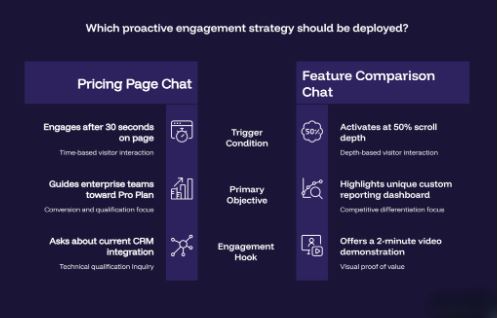
For Pricing Pages (Trigger: 30 seconds on page):
“Hey there! I see you’re looking at our pricing tiers. Most enterprise teams of 10+ people go with the Pro Plan, but I’m happy to help you compare the features. What CRM are you currently integrating with?”
For Feature Comparison Pages (Trigger: Scroll depth of 50%):
“Noticing how we stack up against XYZ Company? The biggest difference is our custom reporting dashboard. Want me to send over a quick 2-minute video showing how it works?”
For E-Commerce Checkout (Trigger: Exit intent or cursor moving to close tab):
“Hold on! Need help calculating shipping to your region, or have a question about our 30-day return policy?”
3. Accelerated Decision Making
Buyers are constantly comparing options. They likely have three browser tabs open right now, comparing your feature set to your top two competitors. The business that removes uncertainty first is almost always the one that wins the deal. By providing instant feature comparisons, delivery updates, or personalized product recommendations in real-time, live chat compresses the traditional B2B research phase from days into minutes. You aren’t just selling a product; you are selling clarity.
4. Conversational Lead Capture
Not every visitor will pull the trigger and buy today, but chat allows you to capture their intent for tomorrow. Compared to a sterile, intimidating contact form with eight required fields, chat conversations feel incredibly low-pressure. By capturing an email address, budget range, and company name naturally in the flow of a back-and-forth conversation, your sales team receives a highly qualified lead. The visitor feels like they had a helpful chat, while your CRM logs a vital new prospect.
5. Hybrid AI and Human Automation
The most effective, modern conversion engines do not rely solely on human agents, nor do they rely entirely on bots. They combine AI efficiency with human empathy. AI chatbots instantly handle repetitive top-of-funnel questions (e.g., “What are your business hours?” or “Where is my login portal?”). When a conversation requires nuance—like negotiating a custom enterprise tier—the AI seamlessly routes the chat to your human agents. This ensures zero downtime, 24/7 lead capture, and a highly personalized experience for high-value buyers.
When NOT to Use Live Chat?
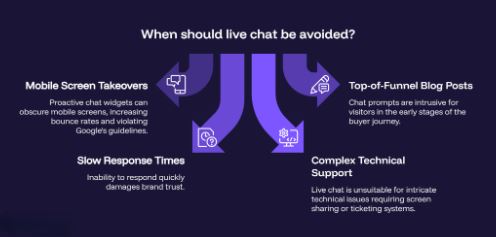
To truly maximize your website’s conversions, you must know when live chat actually hurts the user experience. Authority is built on honesty, and there are times when you should actively suppress your chat widget. Do not use proactive live chat in these specific scenarios:
- Mobile Screen Takeovers: A chat widget that pops open automatically and obscures a mobile user’s entire screen will instantly spike your bounce rate. Google’s mobile-friendly guidelines actively penalize intrusive interstitials. Keep widgets minimized as a small icon on mobile devices until the user explicitly taps them.
- Top-of-Funnel Blog Posts: If a visitor is reading a high-level educational blog post (like “What is Customer Support Automation?”), their buying intent is incredibly low. A proactive “Ready to buy?” The chat prompt is tone-deaf and intrusive. Save your proactive triggers for bottom-of-funnel URLs like pricing, feature comparisons, and checkout pages.
- When You Cannot Reply Fast: If your team does not have the bandwidth to answer a live human chat within a minute, turn the human routing off and use an AI-assisted lead capture bot instead. Nothing destroys brand trust faster than a “Live” chat header that leaves a customer staring at a blank screen for 20 minutes.
- Highly Complex Technical Support: If a user is logged into your software and struggling with a massive server outage or a deeply technical API integration, live chat is often the wrong medium. These situations usually require screen sharing, ticketing systems, and asynchronous deep dives.
Live Chat vs. Contact Forms – A Structural Breakdown
While contact forms still have a place on a dedicated “Contact Us” page, they are fundamentally ill-equipped to handle mid-funnel conversion friction.
| Feature | Live Chat Widget | Traditional Contact Form |
| Response Time | Seconds (Instant gratification) | Hours to Days (Delayed friction) |
| Visitor Engagement | Highly interactive, personalized, and conversational | Passive, one-sided, and formal |
| Lead Qualification | Real-time routing based on user’s instant answers | Manual sorting required after submission |
| Conversion Impact | Influences the active decision process before they leave | Reacts only after the visitor has abandoned the site |
Real-World Case Study – Boosting SaaS Demos by 22% in 14 Days
Generic advice only goes so far. Let’s look at a concrete application of these principles.
A mid-sized logistics management software client came to SupportSuite247 struggling with alarming bounce rates on their enterprise pricing page. Their software was excellent, but buyers were confused by the custom quoting process required for large fleets, causing them to leave the site without booking a demo.
Instead of spending three months overhauling the website’s architecture, we implemented a single, highly targeted proactive chat trigger. If a user idled on the “Enterprise Tier” column for more than 30 seconds, a widget silently slid open with a targeted prompt: “Need a custom quote for 50+ drivers? I can calculate that for you right now.”
The Implementation Results:
- The bounce rate on the pricing page dropped by a massive 18% within the first week.
- Qualified enterprise demo bookings increased by 22% over a 14-day period.
- The average time-to-close on those specific leads was reduced by a full week, as initial discovery questions (fleet size, current software) were handled instantly in the chat rather than over a lengthy discovery call.
Things We Learned Analyzing 1,000+ Chat Logs
First-hand experience fundamentally changes how you view website optimization.
After analyzing thousands of interactions through the SupportSuite247 platform, here is what actually moves the needle in the real world:
- The 35-Second Rule is Absolute: Our aggregate data shows that conversion rates drop by a staggering 40% if a live chat is not answered by a human or an AI within 35 seconds. In the modern web, speed is not a luxury; it is a structural requirement for success.
- Brevity Converts Better: Shorter, punchier chat conversations convert at a higher rate than long, drawn-out ones. The goal of a chat agent is to remove a specific roadblock and immediately point the user toward the checkout or demo booking link, not to have a lengthy consultation.
- Transcripts are a Content Goldmine: The absolute fastest way to optimize your website’s copy is to read your chat transcripts weekly. If 20 different people ask the exact same question in chat this week, that answer needs to be permanently written as a headline on your landing page by next week. Chat reveals such gaps in your marketing.
Turn Traffic Into Revenue with SupportSuite247
Businesses often waste thousands of dollars trying to acquire new top-of-funnel traffic, completely ignoring the highly qualified visitors who are already sitting on their highest-intent pages. Improving conversations with your existing traffic yields drastically faster, more profitable results than launching yet another top-of-funnel advertising campaign.
SupportSuite247 is built from the ground up for ambitious teams that want to stop losing lucrative deals to simple, unanswered questions. Our platform easily merges AI automation for instant top-of-funnel answers with powerful routing tools to get your human agents into the most critical, high-value conversations.
Stop letting buyers leave in silence. Implement SupportSuite247 today to add proactive chat, automate your lead capture process, and finally turn your website into your most reliable revenue channel.