
Every new customer adds to your support debt. As your user base grows, your customer service budget is forced to grow right alongside it.
Most founders try to solve this by simply hiring more human agents. While this approach works temporarily, it quickly destroys profit margins.
Meanwhile, contact center managers face constant pressure to keep wait times low, even as finance departments freeze headcount.
In the wake of it all, traditional math fails.
We’ve watched growing companies bleed capital trying to out-hire their ticket volume, and we don’t want that to happen to you. In a digital-first economy, AI chatbots offer a direct way out.
By automatically handling routine questions, they drastically reduce the agent hours required to run a support department.
The best part? You significantly cut your operational expenses.
So, how exactly does an AI chatbot transform your customer support? Let’s find out.
Why Are Customer Support Costs Increasing?
Running a contact center requires heavy capital allocation.
Base salaries for support representatives increase annually.
Beyond payroll, companies pay for software licenses, hardware, health benefits, and office space for every new hire.
A standard tech stack includes a CRM, a ticketing system, internal communication tools, and cloud telephony. Vendors price these tools per seat. Adding even a single agent often costs hundreds of dollars a month in software subscriptions alone.
On average, an agent spends eight hours a day dealing with frustrated customers and typing out identical answers. HubSpot data shows customer service teams suffer annual turnover rates between 30 and 45 percent. When an agent quits, the company loses the thousands of dollars spent on recruiting and training. Replacing a single agent costs roughly 20 percent of their annual salary according to conservative estimates.
Customer expectations compound to this financial strain. Zendesk reports that 50 percent of consumers will switch to a competitor after one bad support experience. Gartner research, on the other hand, indicates that customer effort is the strongest driver of loyalty.
If you want to prevent churn, you must provide immediate & accurate support. Staffing a human team to provide that level of support around the clock requires constant capital injection.
Deloitte surveys show 79 percent of contact center leaders plan to invest in artificial intelligence to manage these rising operational demands.
How AI Chatbots Reduce This Burdening Cost?
Most businesses overestimate how many conversations should remain fully manual.
Customers expect a fast answer to their simple question.
They do not want a twenty-minute conversation with a human just to find out their tracking number.
Bots can easily intercept these simple queries before they hit the human queue.
Handle repetitive questions
Look at your ticket queue. A large portion of daily support tickets revolves around three or four predictable topics. Customers ask how to reset passwords, where their orders are, or how to process a return. Human agents waste hours typing identical answers to these questions every day. IBM data shows chatbots can answer up to 80 percent of routine questions without human intervention.
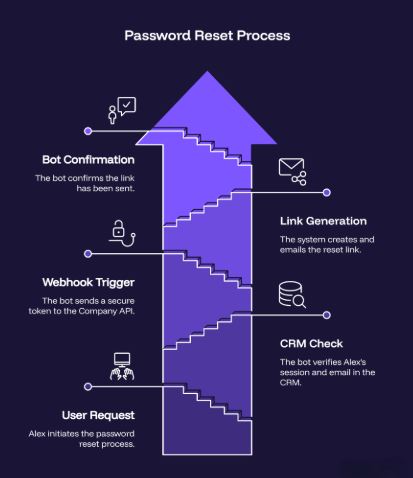
When a bot handles a password reset, it triggers a webhook to your database and emails the link instantly. The company pays a fraction of a cent for the API call. If a human handles that same ticket, the company pays for the minutes the agent spent reading the request, finding the account, and pasting the link. Multiplying that time savings by thousands of tickets per month results in massive cost reductions.
ChatBot Workflow
- Trigger: Alex tells the bot, “I can’t log in.”
- Authentication: The bot instantly reads Alex’s user ID or asks for their email address. It checks the company’s CRM to verify the account exists.
- Webhook API Call: The bot triggers a predefined webhook (a lightweight API request) to your backend database: POST /api/v1/auth/reset-request.
- Resolution: Your system automatically generates a secure, timed token, emails the link to Alex, and the bot messages Alex: “I just sent a reset link to your email! Check your spam folder if you don’t see it in a minute.”
- Ticket Closes: The bot logs the interaction as “Resolved” in your ticketing system (like Zendesk or Jira) and closes it.
Human Workflow
Now, let’s look at what happens if that same request goes into a queue for a human agent.
- Step 1: Triage (1-2 mins): The ticket sits in a queue until an agent becomes available. The agent opens the ticket, reads it, and types a canned greeting: “Hi Alex, I can certainly help you with that.”
- Step 2: Database Look-up (1-2 mins): The agent minimizes the support dashboard, opens the internal admin console or CRM, copies Alex’s email from the ticket, and searches for the account to ensure it’s active and not banned.
- Step 3: Verification & Manual Trigger (1 min): The agent clicks a button in the admin panel that says “Generate Password Reset.”
- Step 4: Reply & Close (1 min): The agent goes back to the support ticket, types out the response, hits “Submit as Solved,” and moves to the next ticket.
How much did it cost to the company?
If an agent makes $20/hour (roughly $0.33 per minute) and spends 5 minutes on this single ticket, that password reset just costs the company $1.65 in labor.
24/7 availability
Customers need help outside of standard business hours. Global businesses have users in multiple time zones. E-commerce stores see heavy traffic on weekends and holidays. Staffing a support team for overnight shifts requires paying premium wages.
Automated systems run constantly without requiring overtime pay. Microsoft reports that 54 percent of global consumers expect brands to respond to customer service questions instantly. A bot provides that immediate response at 3:00 AM on a Sunday. The business captures sales and resolves issues overnight without expanding the payroll.
Reduce staffing requirements
Growth usually forces a company to hire more agents. If ticket volume doubles, management assumes the support staff must double. Chatbots break the direct link between user growth and headcount. Conversational tools will reduce agent labor costs by $80 billion by 2026 according to Gartner projections.
A trained system acts as a filter. It resolves the easy tickets and passes complex problems to the human team. A company might double its user base but only need to hire one specialized agent instead of ten generalists. The business saves money on recruitment, salaries, benefits, and training.
Faster response times
Long wait times cost businesses money through lost sales. When a customer sits in a Live Chat queue for twenty minutes, they abandon their cart. Salesforce reports 68 percent of customers would rather use self-service channels than wait for an agent.
Bots respond the second a user opens the chat window. They pull order numbers from the database instantly. The customer gets their answer and leaves. The company avoids the financial hit of a lost customer.
Improve productivity
Agents answering basic questions experience cognitive fatigue. Their productivity drops. They make mistakes on complex tickets because their attention is depleted. Accenture estimates automation could boost profitability by 38 percent across industries by removing tedious tasks from workflows.
When bots handle repetitive work, human agents focus on high-value interactions. They troubleshoot technical bugs and negotiate billing disputes. They handle fewer tickets overall. The tickets they do handle have a direct impact on revenue retention.
Increase agent efficiency
Automation assists human agents behind the scenes. Forrester found cognitive technologies can save businesses up to 30 percent in customer support by aiding employees. When a bot transfers a chat to a human, it summarizes the conversation. The agent does not have to read twenty lines of text to understand the problem.
Software tools also draft email responses for agents to review. They suggest links to internal documentation based on the customer’s question. The agent spends less time searching for information. This efficiency allows each agent to handle a higher volume of complex tickets.
Reduce ticket volume
Every ticket represents a cost. Deflecting tickets before they are created saves money. Juniper Research estimates chatbots will save businesses 2.5 billion hours in customer service interactions.
Bots proactively offer help based on user behavior. If a user lingers on a checkout page, a widget can ask if they need clarification on shipping costs. This answers the question before the user clicks the contact button and generates a formal ticket. Lower ticket volume translates directly to lower operational costs.
Cost Comparison – AI vs Human Support
Human support costs scale linearly. Automated support costs scale logarithmically.
A business paying an agent $20 an hour to handle four chats an hour is paying $5 per interaction. A bot handling those same four chats costs pennies.
| Metric | Human Support | AI Chatbot Support |
| Cost Per Interaction | $3.00 to $8.00 | $0.05 to $0.20 |
| Availability | Scheduled shifts | 24/7/365 |
| Onboarding Time | 2 to 6 weeks | 1 to 3 days |
| Handling Capacity | 1 to 3 chats at a time | Unlimited simultaneous chats |
| Scaling Cost | High | Low |
| Consistency | Varies by fatigue level | 100% consistent answers |
The financial benefit appears during volume spikes.
If a marketing campaign drives a thousand inquiries in one day, the software handles them at no extra fixed cost.
The human team would require paid overtime or fail to answer them.
ROI Examples
McKinsey research shows technology adoption in customer service operations can decrease costs by up to 30 percent.
Businesses see this return in specific operational metrics.
Consider Klarna, a global payments brand receiving millions of support chats a month. Their human teams struggle during peak volume spikes. The brand implements an OpenAI-powered support bot. The system resolves 2.3 million inquiries automatically.
The company avoids hiring 700 equivalent workers. This drives a $40 million profit improvement. The remaining human agents handle complex issues faster.
Let’s consider another scenario…
Autodesk faces a very different CS problem.
Technical support tickets take an average of 38 hours to resolve.
They deploy an assistant that asks troubleshooting questions and collects log files before routing the ticket to an engineer. The engineer receives the ticket with all data attached. Resolution time drops to 5 minutes. Bain & Company data shows a 5 percent increase in customer retention produces more than a 25 percent increase in profit.
This tells us, faster technical resolution keeps users from canceling subscriptions.
Common Automation Mistakes We Need to Avoid
In our experience, we have found that forcing users through automation loops damages trust faster than long wait times. Companies implement software with the goal of entirely blocking customers from reaching a human. They hide the contact phone number and build systems that cannot understand nuance.
PwC research found 59 percent of consumers feel companies have lost the human element of customer experience. This happens when a bot gives a wrong answer and refuses to transfer the chat. Customers become infuriated when they type “talk to a person” and the screen replies with a canned error message.
Another mistake involves deploying untrained systems. Machine learning requires access to up-to-date knowledge bases. If a company updates a product but forgets to update the training data, the bot gives incorrect instructions. Businesses must treat the software as an employee that requires continuous training and database synchronization.
How SupportSuite247 Helps Reduce Costs
SupportSuite247 provides the infrastructure to manage support expenses. Our bots integrate directly into your existing data. The system reads your past tickets, help center articles, and website content to learn how your business operates.
We built our platform to focus on Customer Support Automation that resolves issues. When a user asks a question the bot cannot answer with high confidence, it transfers the conversation to your team. You can add Live Chat to a website in minutes using our tools. We know Live Chat increases website conversions by providing immediate answers at the point of sale.
Review our Pricing to see how the software compares to the cost of a single new hire. Start a Free Trial today to test the tools on your own documentation. Reduce support costs with SupportSuite247’s AI-powered customer support platform.
Conclusion
Controlling customer support costs requires managing ticket volume. Hiring more people is an expensive fix. Bots intercept routine inquiries before they consume human labor hours. Companies save money on salaries, reduce agent burnout, and provide immediate answers. Implementing a trained system protects the bottom line while maintaining fast resolution times.